
Pigmentation is one of those things that creeps up on you.
It might start as a small dark patch after a breakout. Or a bit of uneven colouring you notice in a certain light. Then one day you’re standing in front of the mirror and thinking — when did this happen, and why won’t it go away?
I hear this from patients every single week. And the part that frustrates me is that many of them have already tried three or four things before they come to see me. Brightening creams from the pharmacy. A facial from a local salon that promised ‘pigmentation removal.’ A home remedy that a cousin swore by. Sometimes these do nothing. Sometimes — especially with over-the-counter creams that contain undisclosed steroids — they make things noticeably worse.
So when someone sits across from me and asks: “Doctor, will a chemical peel help my pigmentation?” — my answer is usually yes. But not always the same yes. Because Indian skin responds very differently to chemical peels depending on what type of pigmentation you have, how deep it sits, and which peel is actually used.
This article is my attempt to give you a clear, honest answer to that question.
Understanding Pigmentation and Its Causes in Indian Skin
Before we talk about what can fix it, it helps to understand what’s actually happening.
Indian skin — classified as Fitzpatrick Types III to VI — has more active melanocytes than lighter skin tones. Melanocytes are the cells that produce melanin, the pigment responsible for your skin colour. When they’re triggered, they produce extra melanin in localised areas, and that’s what shows up as dark patches, uneven tone, or stubborn spots.
The triggers vary. Post-inflammatory hyperpigmentation — the dark mark left behind after acne, a rash, or even a small injury — is by far the most common complaint I see in patients between their 20s and early 40s. Then there’s melasma, which is hormonally driven and shows up as larger, symmetrical patches across the cheeks and forehead — often linked to pregnancy, PCOS, or the pill. And then sun-induced pigmentation, which catches many Bangalore patients off guard because they don’t associate this city’s weather with serious UV exposure. It is. Bangalore’s UV index is significant year-round.
One thing I see regularly that doesn’t get enough attention: patients whose pigmentation has worsened because of a skin-lightening cream they bought without a prescription. Many of these products contain corticosteroids. Used long enough, they damage your skin barrier and deepen pigmentation. If that sounds like your situation, please stop using it and see a dermatologist before doing anything else.
Benefits of Chemical Peels for Pigmentation Treatment

So why do chemical peels work for pigmentation? The simple version: they remove the outer layers of skin where much of that accumulated pigment lives, and they signal the skin to renew itself faster than it normally would.
When the peeling resolves — usually within a week — what’s underneath is fresher, more evenly toned skin. And because the cell renewal process has been accelerated, the skin continues to improve in the weeks following each session.
What I appreciate about peels, clinically, is their versatility. A well-chosen peel addresses pigmentation, yes — but it also tends to improve skin texture, reduce dullness, and fade acne marks at the same time. For patients dealing with multiple concerns, that’s a meaningful advantage over a single-purpose treatment.
I do want to be upfront about something, though. Peels are not a one-session fix. And they are not a permanent solution for melasma, which can return with sun exposure or hormonal changes no matter how good the treatment was. Realistic expectations matter — and any dermatologist who tells you otherwise is overselling.
Types of Chemical Peels for Indian Skin

This is where it gets genuinely important — and where I’ve seen patients get let down by treatments that weren’t right for their skin.
The wrong peel on Indian skin doesn’t just fail to improve pigmentation. It can make it worse. Aggressive peels trigger the very melanocytes we’re trying to calm, causing a flare of post-inflammatory hyperpigmentation that can take months to resolve. This is not rare — it happens when peels are done without a proper skin assessment, usually in salons or clinics that use a standardised protocol regardless of skin type.
Here’s how I think about peel selection for Indian patients:
Superficial Peels — Where I Start With Most Patients
For first-time peel patients or anyone with mild to moderate pigmentation, I start with a superficial peel. These work on the outermost skin layer only. The risk of adverse reactions is low. The downtime is minimal — a day or two of mild flaking at most.
My go-to for darker skin tones is mandelic acid. Its larger molecule structure means it penetrates slowly and evenly — which translates to less irritation and a much lower risk of PIH compared to glycolic acid. For patients with acne-related pigmentation, I often use a salicylic-mandelic combination, which addresses both the active breakouts and the marks they leave behind. Glycolic acid peels work well too, but I always start at lower concentrations and build up based on how the skin responds.
Medium-Depth Peels — For Stubborn or Deeper Pigmentation
When superficial peels have done their job but results have plateaued, a TCA (Trichloroacetic Acid) peel at 15–25% concentration is the next step. These go deeper into the skin and can produce more dramatic improvement.
But I want to be clear about this: on Indian skin, medium-depth peels require preparation. I typically prescribe 4–6 weeks of a priming routine beforehand — retinoids, azelaic acid, or hydroquinone-based creams — to quieten the melanocytes before the peel. Skipping this step significantly raises the risk of PIH. Downtime is also real: expect 5–7 days of visible peeling and redness. This isn’t something you schedule before an important event.
Deep Peels — Not for Indian Skin
Phenol-based deep peels carry too high a risk of permanent pigmentation changes on Fitzpatrick Type III–VI skin. I don’t recommend them for the vast majority of Indian patients, and if another provider is suggesting one for routine pigmentation, I’d strongly encourage a second opinion.
Not sure which peel is right for your skin?Start with a consultation. Dr. Swetha will assess your pigmentation, skin type, and history — then build a plan around you.
How Chemical Peels Improve Skin Tone and Texture
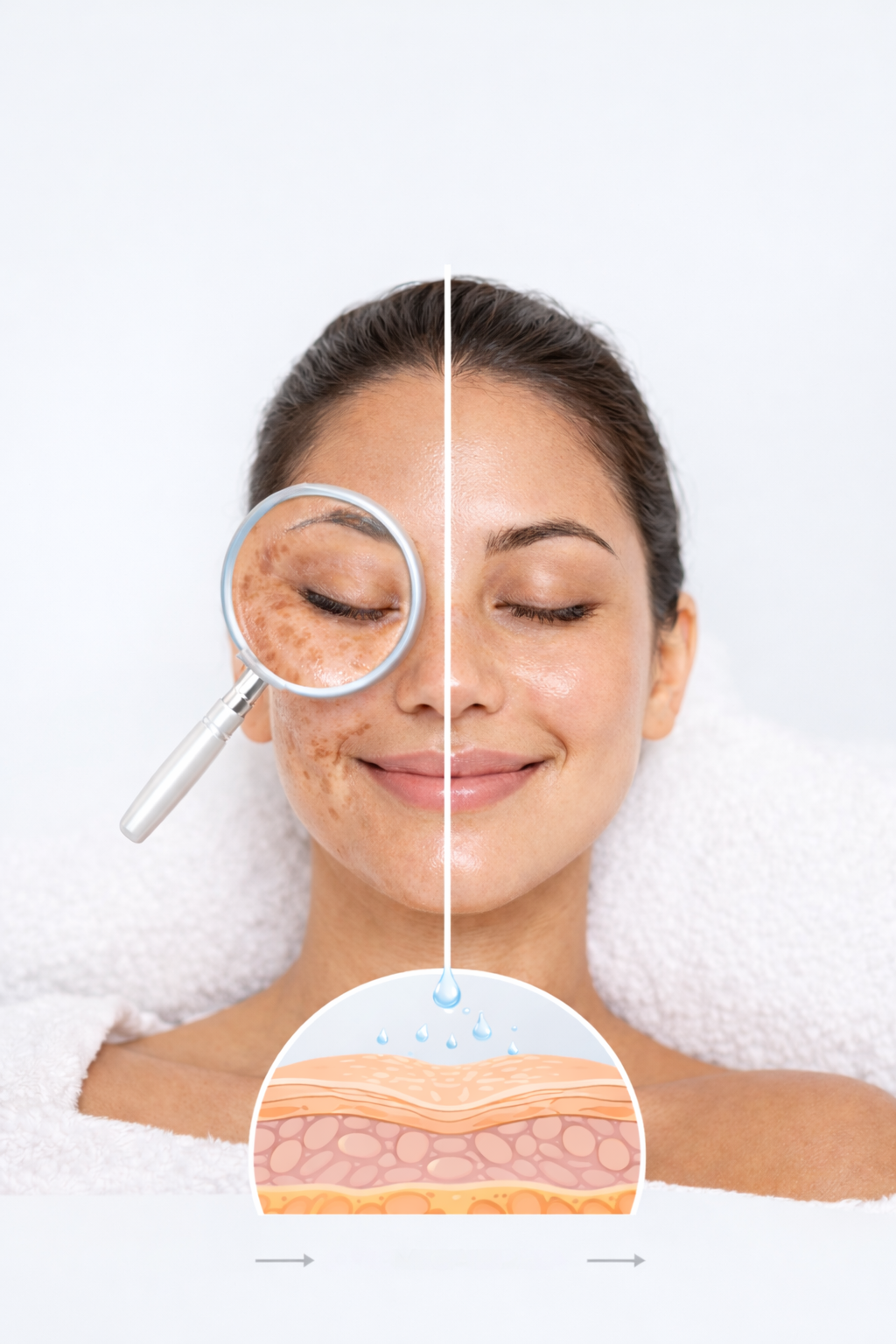
When the acid is applied, it breaks down the bonds holding dead, pigment-loaded skin cells together. Those cells shed. The skin underneath — which hasn’t had as much accumulated melanin — is more even in tone and often noticeably brighter. That part most people understand.
What’s less obvious is what happens beneath the surface. The controlled exfoliation sends a signal to the skin: repair mode. Collagen production increases. Cell turnover accelerates. And certain peels — particularly those with kojic acid components — actively inhibit the enzyme that drives melanin production, meaning the skin is doing less of what caused the pigmentation in the first place.
This is why patients who complete a full course of sessions and maintain their home routine see results that go beyond just faded spots. Skin texture improves. The overall tone becomes more consistent. The face just looks — healthier. Less tired.
But I want to be honest about one thing: if you go back to skipping sunscreen, or if your hormonal triggers haven’t been addressed, pigmentation will return. The peel doesn’t change your biology. It resets a surface condition. Maintenance matters.
The Best Chemical Peel Options for Indian Skin
Rather than listing every peel type, let me tell you what I actually recommend based on what I see in my clinic:
If you're coming in for the first time with post-acne marks or general uneven tone, I'll almost always start with mandelic acid. It's predictable, gentle enough for most Indian skin tones, and effective from session 3 onwards for most patients.
If your pigmentation is linked to ongoing or recent acne, a salicylic-mandelic combination is more targeted — it handles both the active skin concern and the marks left behind.
For sun-induced pigmentation — broad darkening across the face or neck — a glycolic acid series tends to give clearer, faster results, but we'll start conservative and see how your skin responds before increasing concentration.
For melasma, I'm more cautious. Melasma is stubborn and hormonally driven, and treating it aggressively often backfires. My approach is usually kojic acid peels combined with a prescription home routine for 5–6 sessions, then reassessing. If that plateaus, TCA with proper preparation is the next conversation.
What to Expect During and After a Chemical Peel
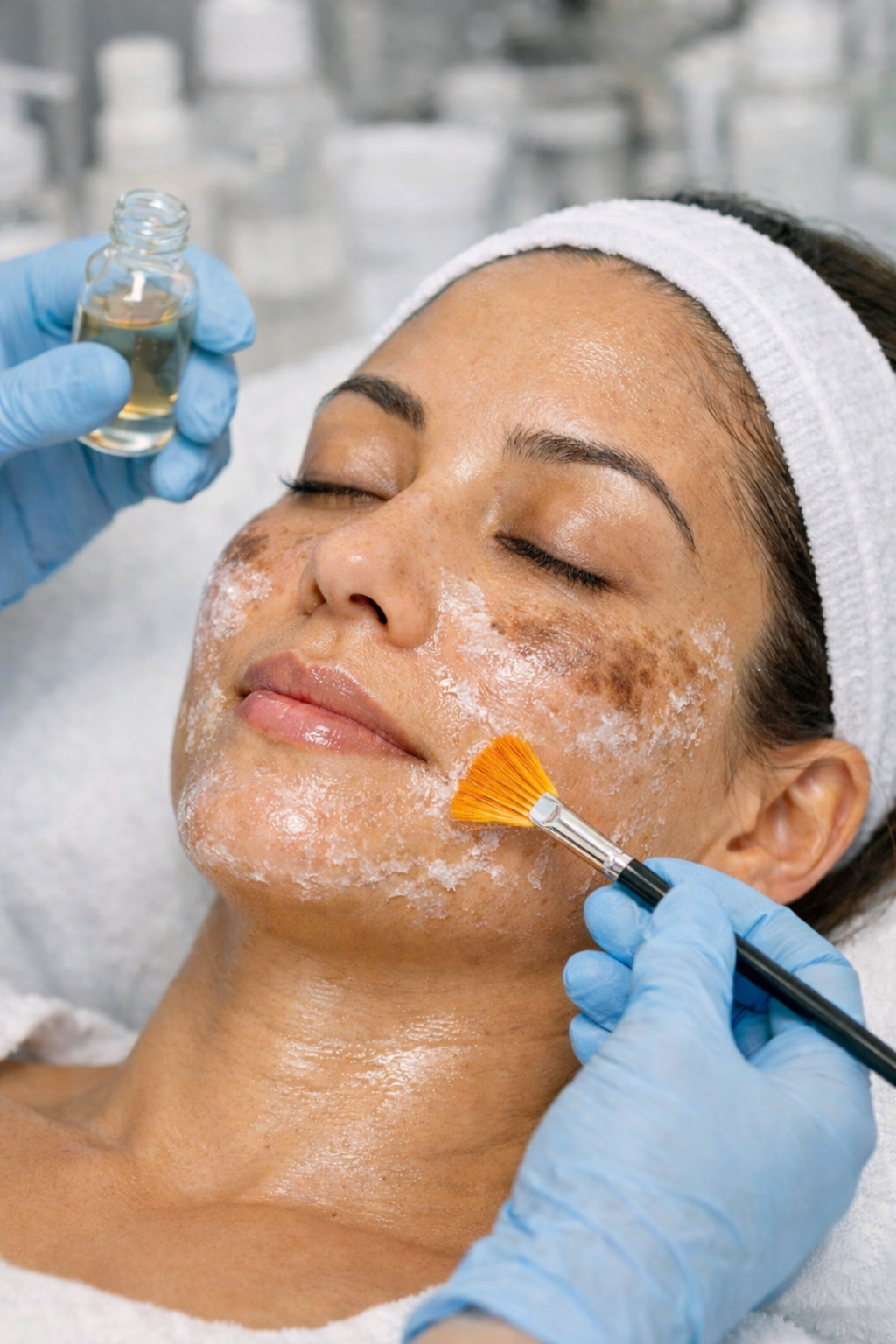
The procedure itself is straightforward. You come in with a clean face — no makeup, no activities. The peel solution is applied with a brush. You feel a tingling, sometimes a mild warmth. We neutralise at the right point and you’re done in 20–30 minutes. Most patients go straight back to work or home without any visible sign that anything was done.
The next few days are where people need managing — not because it’s painful, but because it doesn’t look great while it’s working.
By day 3 or 4, the skin starts to flake — usually around the mouth and chin first. It looks like dry, peeling skin. Not dramatic strips. Not raw. Just flaking. By day 6 or 7, it’s resolved, and what’s underneath is noticeably clearer.
The instruction I give every patient: do not pick it. I know it’s hard. But manually removing peeling skin before it’s ready disrupts the healing layer beneath it, and that’s one of the most reliable ways to cause the PIH we’re trying to treat.
Post-Treatment Care for Optimal Results

Aftercare is not optional — it’s where results are either locked in or lost.
The absolute non-negotiable: SPF 50 every morning. No exceptions. Not on cloudy days, not when you’re staying indoors and stepping out briefly. Freshly exfoliated skin is more vulnerable to UV damage, and UV exposure is the fastest way to reverse everything the peel just achieved.
For the first week after a peel, your skincare routine should be deliberately boring: the gentle cleanser we recommend, a ceramide moisturiser, and sunscreen. Nothing else. No vitamin C, no retinoids, no AHAs from your usual routine. Let the skin heal without interruption.
No gym, steam rooms, or saunas for 48–72 hours — heat increases blood flow to the surface and intensifies redness in freshly peeled skin.
From week two, once the skin has settled, we’ll reintroduce your actives one at a time. A vitamin C serum in the morning, your prescribed retinoid at night. Consistency between sessions matters as much as the sessions themselves.
Come in for a consultation at Cosmoderm Centre, Indiranagar. Near the Metro Station. Weekday and weekend appointments available.
Frequently asked question.
Is a chemical peel safe for dark Indian skin?
Yes — when the right peel is chosen and your skin is properly assessed. Superficial peels like mandelic and lactic acid are particularly well-suited to Indian skin tones. The risk of complications rises with medium and deep peels, which is why proper preparation matters. A qualified dermatologist will always evaluate your skin type before recommending anything.
How many sessions will I need?
Most patients with mild to moderate pigmentation start seeing improvement from session 3, with meaningful results by session 5 or 6. Deeper or hormonal pigmentation like melasma may need more, and often works best in combination with a prescribed home routine. I give every patient a realistic picture of what to expect at the first consultation — not a package number.
Will the pigmentation come back?
It depends on what caused it. Sun-induced pigmentation can recur if you stop using SPF. Melasma tends to return with hormonal triggers or unprotected sun exposure regardless of how well it was treated. For most patients, a combination of maintenance sessions and a consistent home routine keeps pigmentation well controlled — but it’s an ongoing commitment, not a one-time fix.
Can I get a peel if I have active acne?
Not in areas with active, inflamed breakouts. But for controlled acne-prone skin, a salicylic acid peel is actually an excellent option — it clears congestion and addresses the marks acne leaves behind simultaneously. We’ll assess your skin first.
How is a chemical peel different from laser treatment for pigmentation?
Chemical peels work through controlled exfoliation — removing pigmented surface cells and triggering renewal. Lasers target melanin directly at a deeper level using focused light energy. Peels are generally better suited to surface-level and mild-to-moderate pigmentation. Laser treatments are better for deeper, stubborn pigmentation that hasn’t responded to peels. Many patients benefit from a combination of both over time.