
HydraFacial uses vortex suction and serums to cleanse pores and extract sebum without surface trauma results in one session. Chemical peels use acid to exfoliate, clear follicles, and reduce oil gland activity over multiple treatments.For active congestion and visible pores, HydraFacial gives faster clearance. For acne, pigmentation, or texture issues, a salicylic or glycolic peel is more precise.
According to Dr. Swetha P, a leading dermatologist in Indiranagar, patients with oily skin often benefit from starting with HydraFacial MD before moving to peels it clears surface congestion and creates a cleaner baseline for acid-based treatments.
How Do HydraFacial and Chemical Peels Treat Oily Skin Differently?
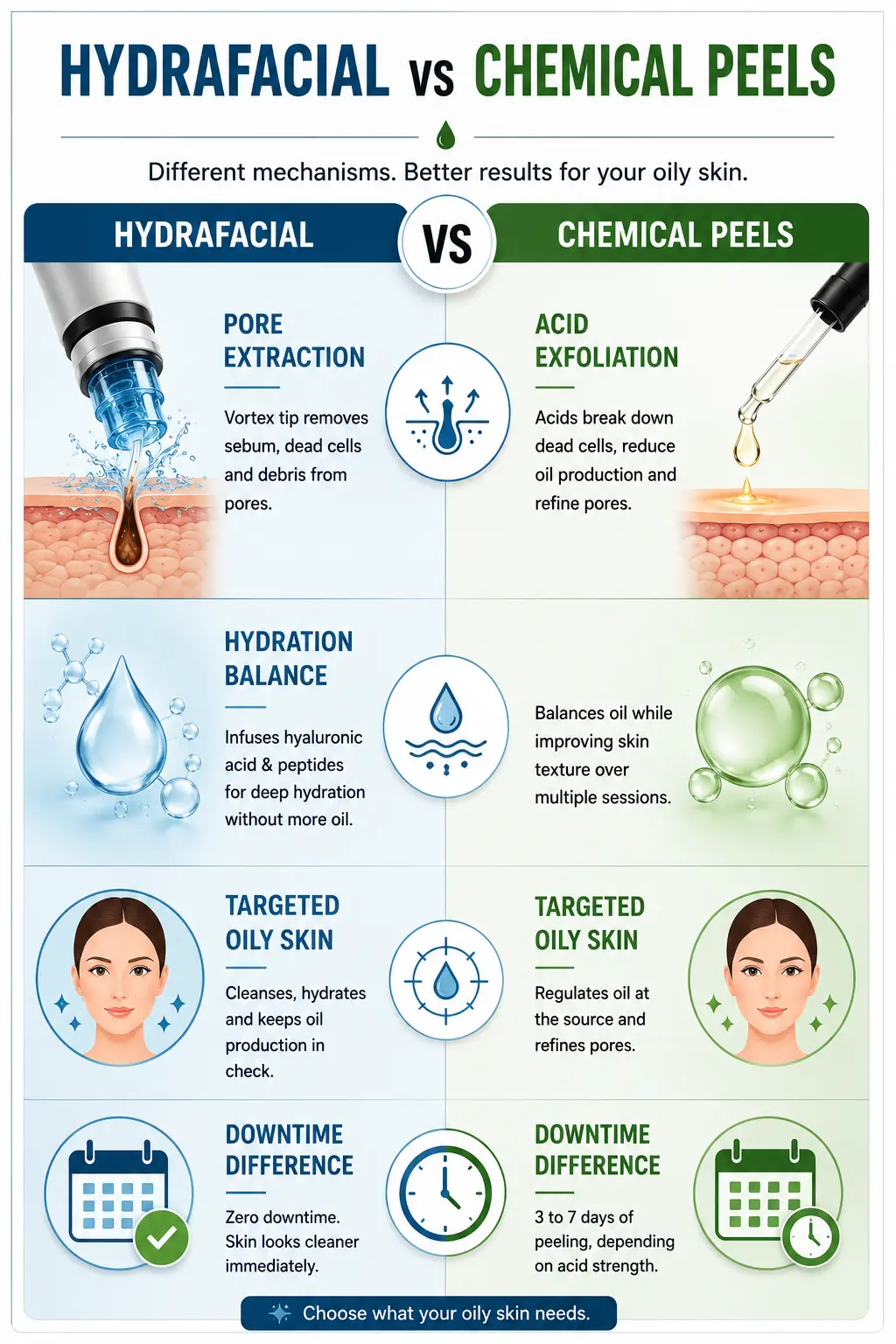
For oily skin that’s also dehydrated or prone to sensitivity, a HydraFacial MD tends to deliver visible results without the recovery burden that comes with acid-based exfoliation.
Which Treatment Works Better for Acne-Prone Oily Skin?
Oily skin with active or recurring acne needs a different approach than oily skin that’s just congested or dull, and the right treatment depends on what’s driving the breakouts.
- Salicylic advantage: Salicylic acid peels are oil-soluble, meaning they penetrate through sebum into the follicle itself to dissolve the comedonal material that sits at the root of acne, something HydraFacial’s suction can’t reach at that depth.
- Active acne caution: HydraFacial’s tip should avoid active pustules during the session, so skin with widespread inflamed acne typically isn’t a great candidate until the active phase is controlled, while low-strength salicylic peels can often be done through mild breakouts.
- Pigmentation overlap: Oily skin that scars with post-acne dark marks responds well to a combination approach, where HydraFacial maintains pore clarity between sessions and a monthly glycolic peel addresses the pigmentation itself at the epidermal level.
- Long-term sebum control: A series of chemical peels actually remodels the follicular structure over time, which reduces oil gland activity more durably than HydraFacial alone, but it requires patient skin and consistent post-peel sun protection.
Choosing between these treatments for acne-prone oily skin comes down to whether the skin is actively inflamed or in a stable phase, and reviewing your chemical peel treatment options with a dermatologist helps determine exactly which acid and concentration matches your current skin condition.
Not sure which treatment your oily skin actually needs right now?
Why Choose Dr. Swetha P?
Dr. Swetha P holds an MBBS and MD in Dermatology, Venereology and Leprosy, with additional laser and aesthetic training from the Middle East, and leads Dr. Swetha’s Cosmoderm Centre in Indiranagar. She’s trained in both HydraFacial MD and chemical peel protocols and regularly combines both for oily and acne-prone skin patients based on a structured skin analysis before the first session.
Patients treated at the centre for oily skin concerns report consistent improvement in pore congestion, sebum control, and acne recurrence within 3 to 4 sessions, because each treatment plan is built around the skin’s actual sebum levels, not a generic protocol.
Frequently asked question.
Is a thread facelift more painful than Botox?
Thread lifts use local anaesthesia and cause more discomfort than Botox injections, which use very fine needles.
Can Botox and thread lifts be done in the same session?
Yes, they’re often combined but the dermatologist decides sequencing based on treatment goals.
How soon do thread facelift results show?
Visible lifting is immediate, with further improvement over 2 to 3 months as collagen builds.
Does Botox stop working if used for too long?
Resistance is rare but possible; most patients maintain consistent results with regular sessions.
Refrences
- Dainichi T, et al. Efficacy and Safety of Superficial Chemical Peeling in Treatment of Active Acne Vulgaris. PubMed, 2017.
- Handog EB, et al. Chemical Peels for Skin Resurfacing. StatPearls, NIH/NCBI.
Disclaimer: This content is for informational purposes only and does not substitute professional medical advice. Consult a qualified dermatologist before undergoing any treatment.