
Thread facelifts last 1 to 3 years compared to Botox’s 3 to 6 months, but longevity isn’t the deciding factor; they treat different problems. Botox relaxes muscles, causing dynamic wrinkles like forehead lines and crow’s feet; thread lifts physically reposition sagging tissue using dissolvable sutures. Botox suits early-stage ageing with muscle-driven lines; thread lifts suit moderate laxity where tissue has dropped and muscle relaxation alone won’t produce a visible lift.
According to Dr. Swetha P, a leading dermatologist in Indiranagar often come in expecting a surgical result, but the procedure is best suited for mild to moderate laxity where the skin still has enough elasticity to hold the lift effectively.
How Long Do Thread Facelifts and Botox Each Last?
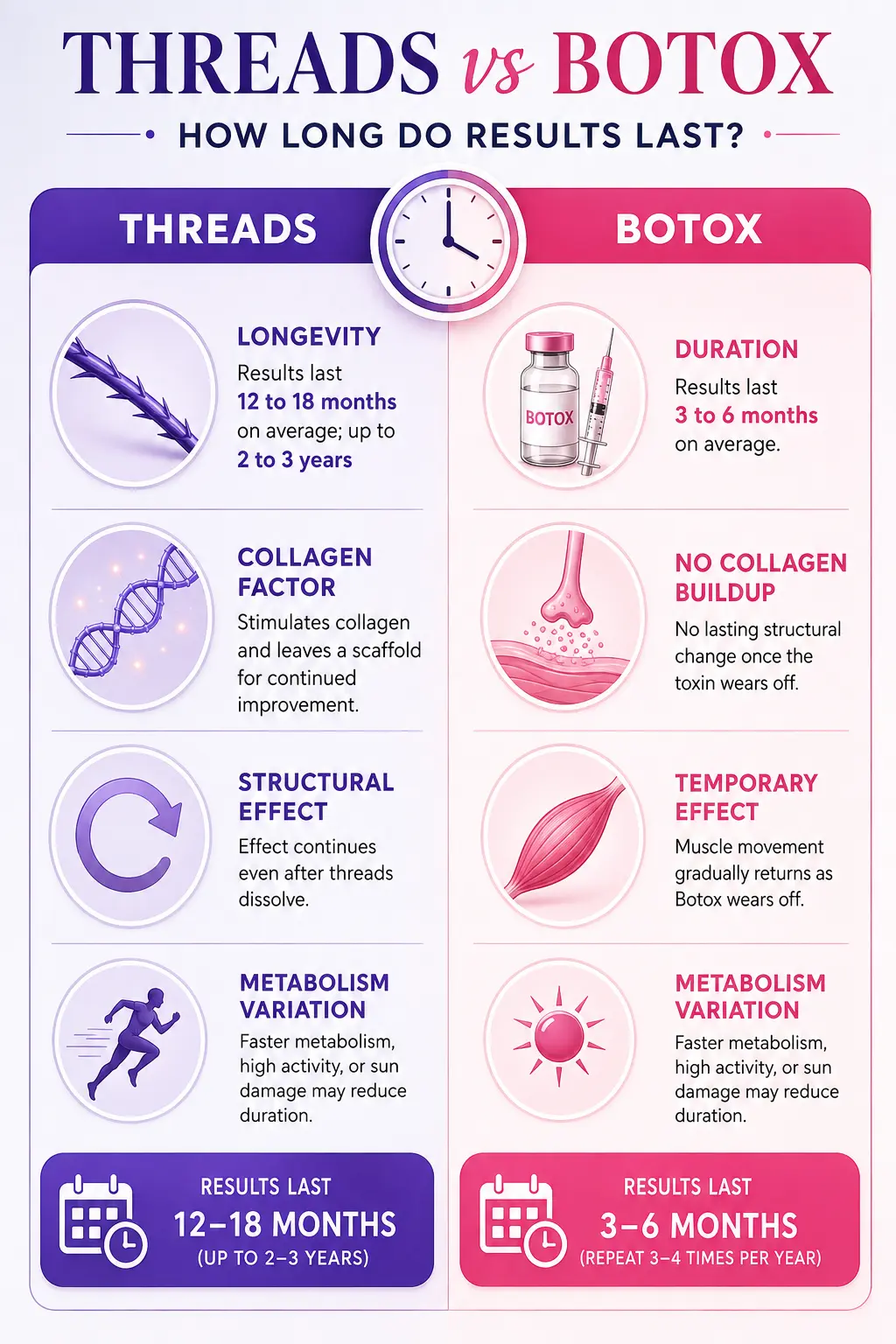
Both treatments require maintenance sessions to sustain results, though the interval between sessions differs considerably, and patients who combine a Thread Lift Treatment with periodic Botox often extend the visible benefit of each compared to using either treatment alone.
Which Treatment Suits Your Skin Concern Better?
The right choice depends less on which lasts longer and more on what the skin is actually doing and what kind of correction is realistically achievable without surgery.
- Dynamic wrinkles: Botox is the correct treatment for lines that appear during facial movement, such as forehead furrows, crow’s feet, and the glabellar lines between the brows, since relaxing the underlying muscle stops the skin from creasing repeatedly.
- Sagging tissue: Thread lifts address gravitational descent of the cheeks, jowls, and jawline where the tissue has physically dropped, a problem that Botox injections can’t correct because muscle relaxation doesn’t reposition or re-anchor fallen skin.
- Age range: Botox tends to work well in the late twenties to early forties when muscle activity is the primary driver of ageing, while thread facelifts are more commonly indicated from the late thirties onward when visible laxity has developed.
- Combination approach: Many patients in their forties benefit from using both together, with threads restoring the structural lift and Botox smoothing the overlying dynamic lines, producing a result that neither treatment achieves as effectively on its own.
Understanding whether your concern is muscle-driven or gravity-driven is the clearest way to decide, and a consultation that includes reviewing what Botox realistically achieves before and after alongside thread lift candidacy gives you a complete picture of what each can deliver.
Wondering whether your skin needs lifting or relaxing to look refreshed?
Why Choose Dr. Swetha P?
Dr. Swetha P holds an MBBS and MD in Dermatology, Venereology and Leprosy, with specialised training in aesthetic procedures including thread lifts, Botox, and dermal fillers, and leads Dr. Swetha’s Cosmoderm Centre in Indiranagar. She evaluates each patient’s skin laxity, facial anatomy, and ageing pattern before recommending a thread lift, Botox, or a combination protocol tailored to the stage of ageing present.
Patients treated at the centre for anti-ageing concerns consistently report natural-looking results with no overcorrection, because treatment decisions are based on a detailed facial assessment rather than a fixed menu.
Frequently asked question.
Is a thread facelift more painful than Botox?
Thread lifts use local anaesthesia and cause more discomfort than Botox injections, which use very fine needles.
Can Botox and thread lifts be done in the same session?
Yes, they’re often combined but the dermatologist decides sequencing based on treatment goals.
How soon do thread facelift results show?
Visible lifting is immediate, with further improvement over 2 to 3 months as collagen builds.
Does Botox stop working if used for too long?
Resistance is rare but possible; most patients maintain consistent results with regular sessions.
Refrences
- Synergistic Facial Rejuvenation with PDO Threads and Botulinum Toxin A for Aging Skin. PMC/NIH, 2024.
- Pugash R, et al. Long-Term Effects of Repeated Botulinum Toxin Injection in Cosmetic Therapeutics. PubMed, 2021
Disclaimer: This content is for informational purposes only and does not substitute professional medical advice. Consult a qualified dermatologist before undergoing any treatment.