

Are sagging cheeks, jowls, or loose skin making the face look older than you feel? If you are considering a facial lifting procedure, you may be wondering whether a thread lift or a traditional facelift would give you the results you want. Each of the procedures addresses signs of facial aging, but in their unique way. While a thread lift is a minimally invasive technique, a facelift involves surgery and gives a more substantial correction for advanced sagging.
Dr. Swetha P., an eminent dermatologist in Indiranagar, Bangalore, emphasises that the type of face-lifting procedure depends on the degree of skin sagging, its elasticity, facial structure, and expected result rather than based only on age or the desire for a particular procedure. All of these aspects should be taken into account when considering any kind of procedure.
At Dr. Swetha’s Cosmoderm Center, a reputed skin clinic in Indiranagar, Bangalore, an individual treatment approach to achieving a refreshed appearance is used while preserving natural facial proportions. With her expertise in aesthetic dermatology and personalized skin treatments, Dr. Swetha P. evaluates individual concerns and recommends suitable options based on each patient’s needs.
Looking for a lift without conventional surgery? Let’s explore how a thread lift works.
What Is a Thread Lift and How Does It Work?
A thread lift is a minimally invasive aesthetic procedure where fine absorbable threads are placed beneath the skin in order to create a supportive and subtle lifting effect. Threads help reposition mildly sagging tissues and stimulate collagen production around the area being treated.
Thread lifts may be considered for concerns such as:
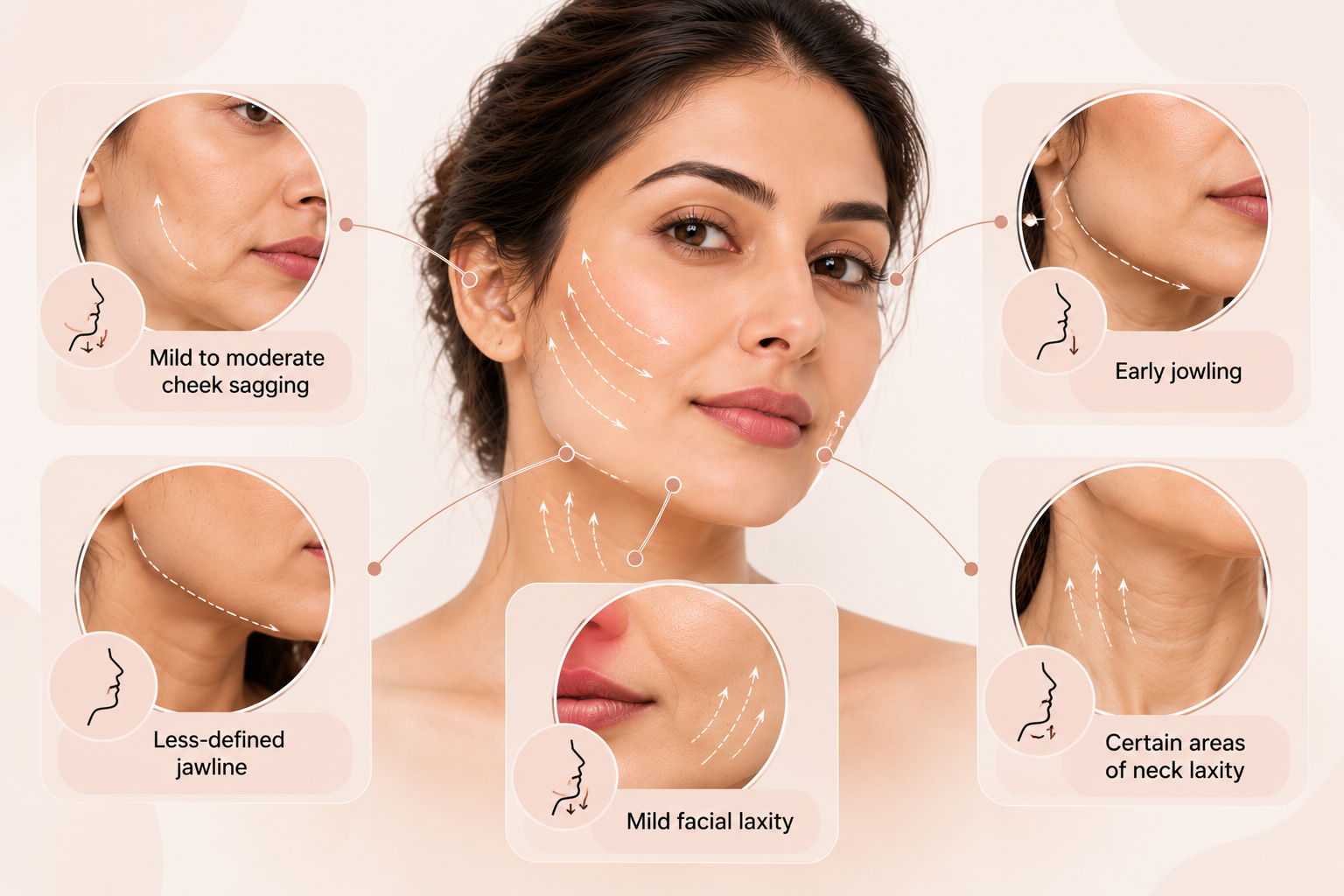
One of the main advantages is the shorter recovery period compared to a surgical facelift. The procedure can be done on an outpatient basis, and local anesthesia can be applied if necessary. The specialist informs that swelling, redness, and bruising are temporary side effects after the procedure, while the lifting effect will develop due to collagen production stimulation.
A thread lift is not designed to reproduce the degree of correction achieved through a surgical facelift. Instead, it can be an option for those who would like to have a subtler lifting without undergoing surgery.
Interested in a minimally invasive lifting option?
Connect with an experienced aesthetic professional to assess whether a thread lift is suitable.
Considering a more significant correction for facial sagging? Let’s discuss what a facelift involves.
What Is a Facelift and How Does It Work?
A facelift, medically known as rhytidectomy, is a surgical procedure designed to address more advanced signs of facial ageing. Depending on the technique, the surgeon may reposition deeper facial tissues, remove or redistribute excess skin, and improve the appearance of sagging around the cheeks, jawline, and lower face.
Unlike a thread lift, a facelift involves surgical incisions and a longer recovery period. However, it can provide a more substantial and longer-lasting correction when there is significant skin and tissue laxity.
A facelift may be considered when someone has:
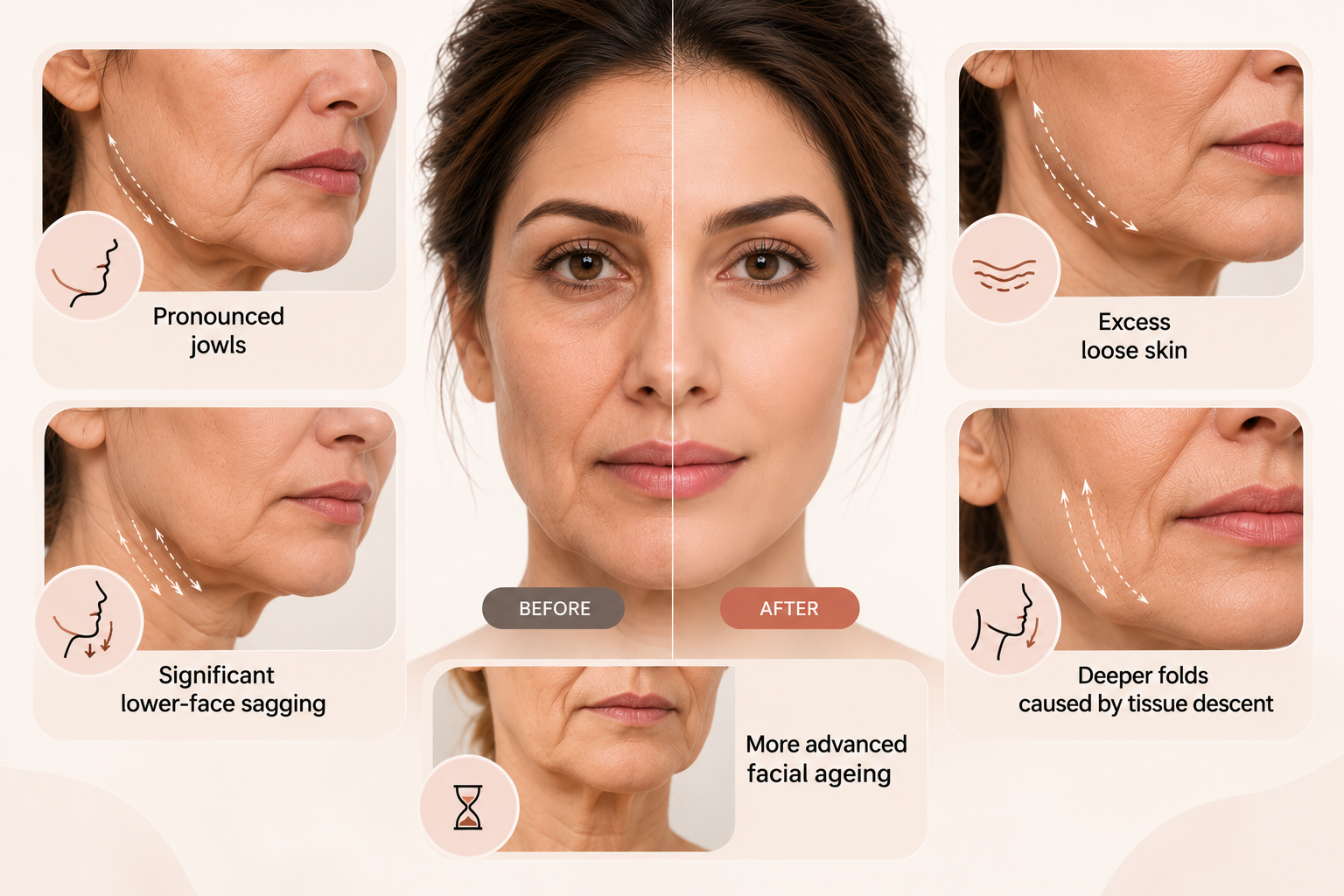
The procedure is generally performed by a qualified plastic surgeon rather than being considered simply a non-surgical dermatology treatment. A detailed consultation is essential to determine whether surgery is appropriate.
Still deciding between the two? Let’s compare the factors that matter most.
Thread Lift vs Facelift: What Are the Key Differences?
| Feature | Thread Lift | Facelift |
| Approach | Minimally invasive | Surgical |
| Incisions | Small entry points | Surgical incisions |
| Anaesthesia | Usually local | Typically more extensive anaesthesia |
| Downtime | Relatively short | Longer recovery |
| Degree of lift | Subtle to moderate | More significant |
| Best suited for | Mild to moderate laxity | Moderate to severe ageing changes |
| Scarring | Minimal entry-point marks | Surgical scars, usually placed strategically |
| Results | Temporary and variable | Generally longer-lasting |
| Collagen stimulation | Yes | Tissue healing also supports collagen remodeling |
The biggest difference is not simply the procedure itself—it is the degree of correction required. Choosing a thread lift when there is substantial excess skin may lead to unrealistic expectations, while undergoing surgery for mild laxity may be more intervention than necessary.
How much sagging makes a difference? Let’s break down which option may fit different stages.
Which Treatment Is Better for Mild, Moderate, or Severe Skin Sagging?
Mild Sagging
A thread lift may be suitable when the skin has relatively good elasticity but early laxity is beginning to affect facial contours. It can provide a subtle lift and support while stimulating collagen.
Moderate Sagging
Both approaches may be discussed depending on the amount of loose skin and the desired result. A thread lift may be considered when someone prefers a minimally invasive approach, while surgery may provide a stronger correction.
Severe Sagging
A facelift is generally more appropriate when there is substantial tissue descent and excess skin. Threads cannot remove significant amounts of loose skin, so they may not provide the desired level of correction in advanced ageing.
Want to know how the results differ beyond the initial lift? Let’s explore what you can realistically expect.
How Do Thread Lift and Facelift Results Compare?
Thread lift results are usually more subtle and are intended to create a refreshed, gently lifted appearance. Some improvement may be visible immediately, with further effects developing as collagen stimulation occurs. Dr. Swetha P. notes that results can continue developing over several weeks following treatment.
A facelift provides a more comprehensive change because it addresses excess skin and deeper tissue laxity surgically. It is therefore generally better suited to patients seeking a significant correction.
Neither procedure should be viewed as stopping the ageing process. Facial ageing continues naturally after either treatment, and factors such as genetics, sun exposure, lifestyle, and skin quality can influence longevity.
Concerned about downtime? Let’s compare what recovery can look like after each treatment.
What Is the Recovery Time After a Thread Lift vs Facelift?
Thread lift procedures generally involve much less recovery time compared to facelifts. There may be some mild swelling, redness, tenderness, or even bruising. These side effects are expected to settle as the healing progresses.
The recovery period for a facelift is longer due to the surgical procedure. The patient may have some swelling and bruising during the early recovery period.
Your expert will give you detailed information about your post-procedure care.
Wondering whether you are a suitable candidate? Let’s explore what professionals consider before recommending either treatment.
Who Is a Good Candidate for a Thread Lift or Facelift?
A suitable candidate is assessed based on facial anatomy, skin quality, degree of laxity, medical history, and expectations.
A thread lift may be considered for someone with:
- Mild to moderate laxity
- Reasonably good skin elasticity
- Specific areas requiring subtle lifting
- A preference for minimally invasive treatment
A facelift may be considered for someone with:
- More advanced skin laxity
- Significant jowling
- Excess facial skin
- Expectations for a more substantial correction
A consultation is important because age alone does not determine which procedure is appropriate.
Feeling stuck between a thread lift and facelift? Let’s discover what should guide your decision.
How Do You Choose the Right Treatment for Your Face?
Start with the result that you actually want and not something based on popularity.
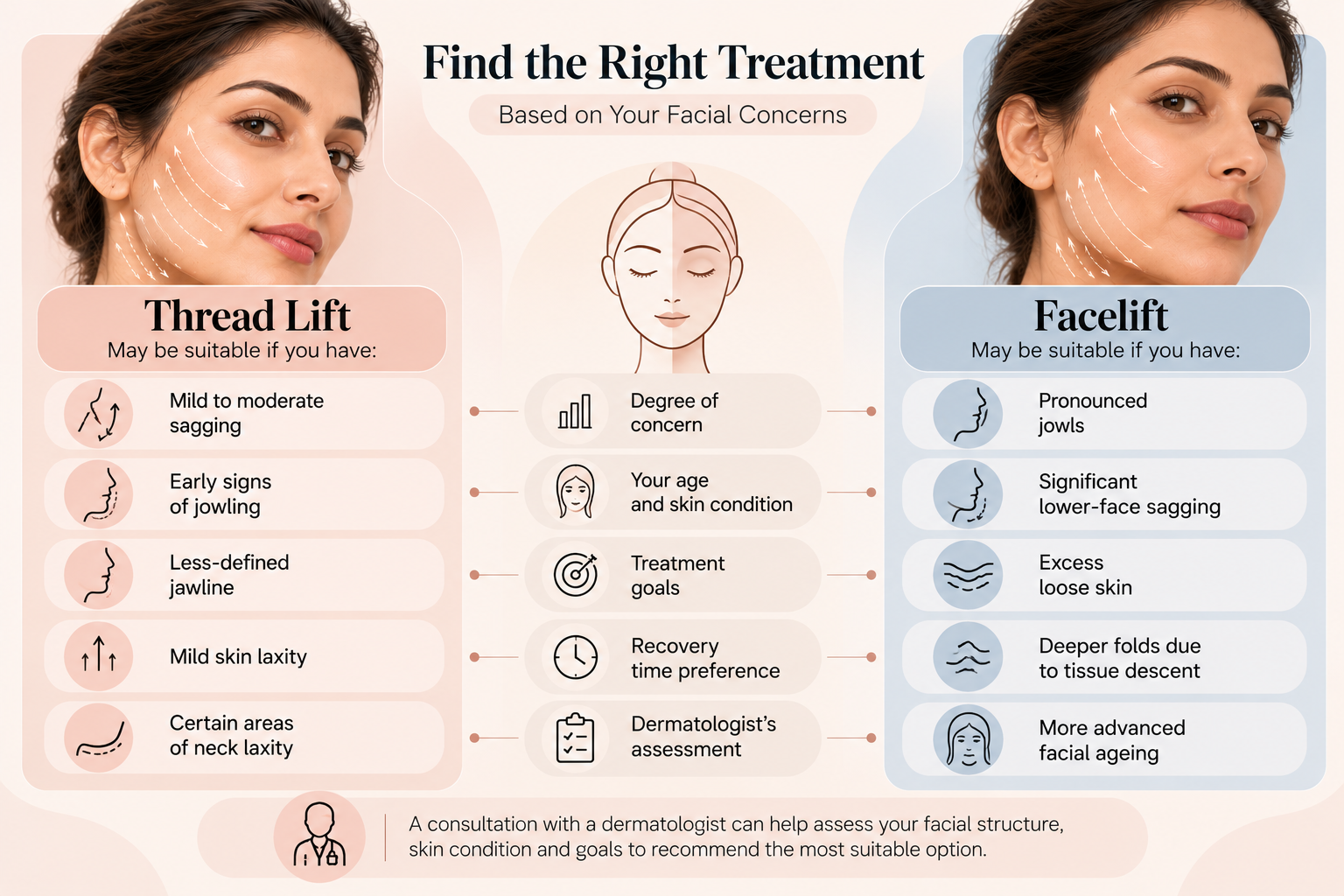
Consider the following:
- Degree of sagging: Mild laxity may respond to minimally invasive lifting, while significant laxity may require surgery.
- Skin elasticity: Better elasticity can influence thread-lift suitability.
- Amount of excess skin: Threads cannot remove substantial loose skin.
- Downtime: A thread lift generally involves less recovery than a facelift.
- Expected longevity: Surgical lifting generally provides a more substantial and longer-lasting correction.
- Natural appearance: Treatment should complement your facial structure rather than dramatically change it.
- Medical suitability: Your overall health and individual anatomy need to be considered.
For anyone considering a thread lift in Indiranagar, a professional consultation would be helpful to find out how well the procedure suits the degree of your facial laxity and desired outcome.
Ready to understand which lifting option is right for your face?
Get in touch with a qualified specialist for personalised guidance.
Frequently asked question.
Is a thread lift better than a facelift?
Neither is universally better. Depending on the patient’s case, a thread lift can be a choice for a mild to moderate degree of laxity, whereas a facelift is better for significant sagging.
How long does a thread lift last?
The duration of the results differs from person to person, depending on many factors including individual characteristics of the skin, aging, lifestyle and type of threads used.
Which one is safer – a thread lift or a facelift?
A thread lift is less invasive, but there is always a risk in any cosmetic procedure. A doctor should have necessary qualifications to perform both procedures.
Does a thread lift look natural?
Provided that a thread lift was appropriately selected and performed, the procedure can result in a subtle lift without changing facial features.
Can a thread lift remove loose skin?
No. Threads can provide support and lifting but cannot surgically remove significant excess skin.
How soon can I see thread-lift results?
Some immediate results are visible, but they can develop further during healing of the area of application and when collagen remodeling occurs.
Is a thread lift permanent?
No, thread lift is temporary, as threads eventually absorb, and facial aging continues.
Refrences
https://pubmed.ncbi.nlm.nih.gov/34699439/
https://www.plasticsurgery.org/cosmetic-procedures/facelift/safety
Disclaimer: The information shared in this content is for educational purposes and not for promotional use.